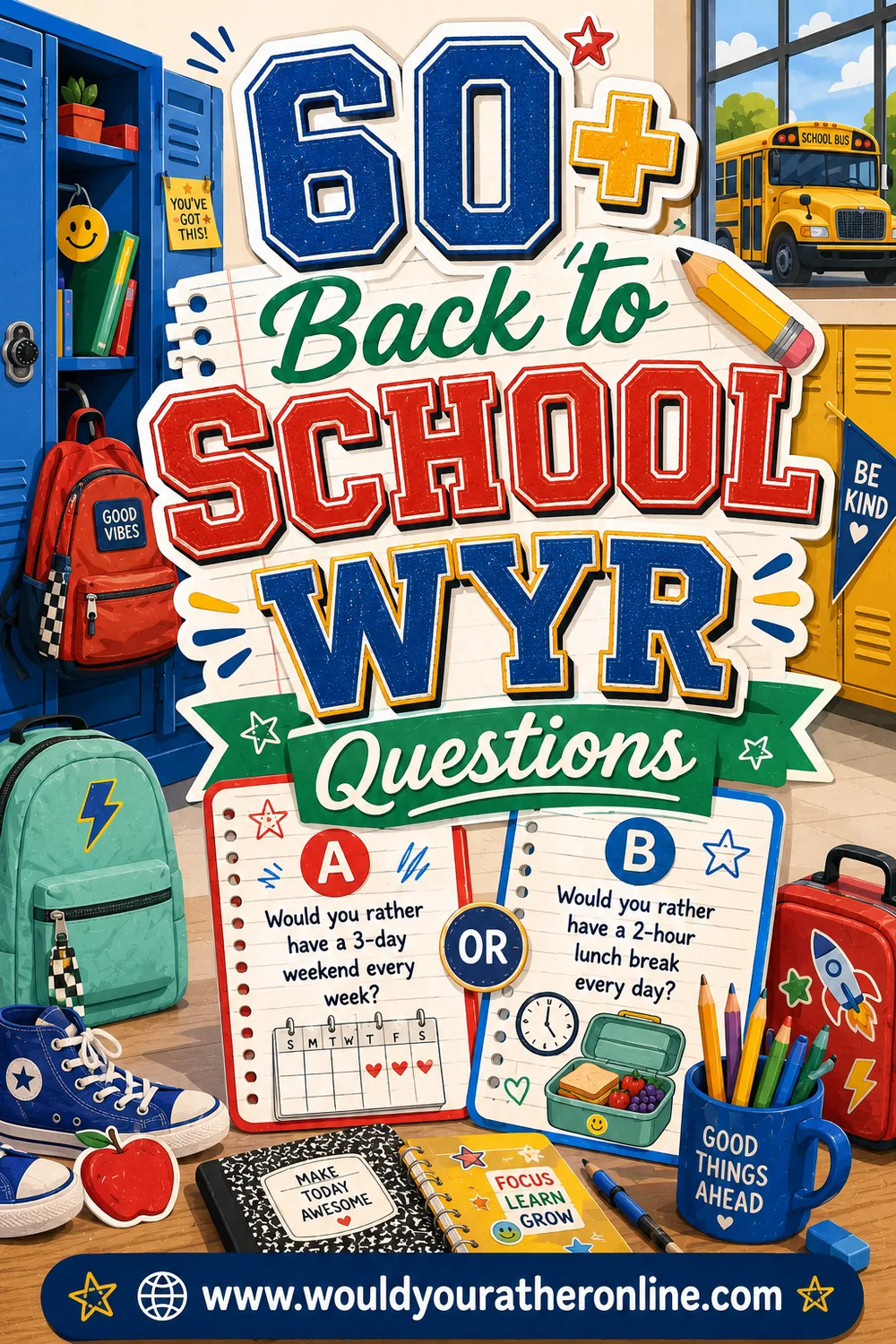
60+ Back to School Would You Rather Questions
The first week of school is the quietest week of the year, and not in a good way. Twenty-five children who mostly don't know each other are sitting in a room they've never sat in, with an adult whose name they learned nine minutes ago, being asked to "tell us something about yourself". Nobody wants to go first. Back to school would you rather questions solve that problem faster than anything else you can do without materials, because a two-option question doesn't ask a nervous child to invent anything — it just asks them to point.
That distinction matters more in week one than at any other point in the year. An open-ended icebreaker requires a student to compose something interesting about themselves, say it out loud, and hope it lands with people they have no read on yet. That is a genuinely hard social task for a nine-year-old on day two, and the ones who most need to be pulled into the group are exactly the ones who will quietly opt out of it. Pancakes or waffles has none of that risk. There is no wrong answer, no preparation, no personal disclosure, and no way to look foolish — and once a child has spoken once in front of the class and nothing bad happened, the second time is dramatically easier.
What follows is built for that specific window: the first few days, before you know their names, before they know each other's, before anyone has settled into who they're going to be in this room. You'll get 60+ questions in five categories, five ready-to-run activities that need nothing but the questions themselves, a note on adapting all of it for older students, and where to go once the first week is behind you.
Why It Works in the First Week
There is no wrong answer, and everyone can see that immediately. On day one, students are running a constant background calculation about whether it is safe to speak in this room. The fastest way to answer that question for them is to ask something that cannot be graded, corrected, or laughed at. When the first student says "summer" and you say "same", the whole room learns something about how this class is going to work — and they learn it in four seconds rather than four weeks.
No prior knowledge is required. This is the practical advantage over almost every other first-week activity. You cannot ask about last year's topics, because you don't know what they covered. You cannot ask about their reading level, their friends, or their summer, because those questions all quietly sort children into haves and have-nots. Pizza or tacos requires nothing but being a person. That makes it equally answerable by the student who has been at the school since Kindergarten and the one who moved here in August and knows nobody.
Quiet students can join without exposing themselves. Every class has three or four children who will not volunteer in September under any circumstances. A two-option question gives them a way in that costs almost nothing: raise a hand, move to one side of the room, or say a single word. It is participation without performance. Teachers who run this in the first week consistently describe the same pattern — the child who whispered "dogs" on Tuesday is offering a reason unprompted by the following Monday, because the bar was low enough to step over.
You learn names faster than by any other method. A name attached to a face in a row of twenty-five faces does not stick. A name attached to a distinctive choice does. When Maya says "I'm Maya, and I'd rather have a pet dragon", your memory has something to hang the name on, and so does every other child in the circle. Run it twice on day one and you will be surprised how much of the register you have by home time.
Students find each other without you assigning it. The most useful thing that happens is sideways, not forward. A child discovers that two other people picked the same weird option, and that is enough to start a conversation at recess. You cannot manufacture friendships in the first week, but you can create a hundred tiny points of overlap and let the students do the rest. That is the real work of a first-week icebreaker, and it is why the silly categories earn their place alongside the serious ones.
5 First-Week Activities
1. Stand on a side. Clear a lane down the middle of the room, name one option for the left wall and one for the right, and let them move. It takes ten seconds per question, works with any class size, and it gets bodies out of chairs on a day when everyone has been sitting too long. The magic is visual: children instantly see who is standing with them, which is far more powerful for a brand-new class than a show of hands. Run four or five questions back to back, and after each one ask a single student on each side why — not everyone, just one, so the pace never drops.
2. Find someone who mingle. Give each student a slip with five questions on it and send them around the room to find one person who chose the same as them for each, writing that person's name next to the question. It is a name-learning exercise disguised as a game, and it forces five separate conversations with five different people in about eight minutes. Set the rule up front: you can only write each name once. Otherwise every child collects the same friend five times, which defeats the entire purpose.
3. Name and answer around the circle. The simplest and, for the first day, the most valuable. Ask one question, then go around the room with each student saying their name first and their answer second, in that order, every time. Everyone speaks, everyone is heard, everyone hears twenty-five names in four minutes. Start at a different point each round so the same child is never first — first is exposed, and on day one that matters. If a student would rather not, let them say "pass" and come back to them at the end, when they have heard the format twenty-four times.
4. Build a class graph. Pick three questions, take a tally for each, and turn the results into bar graphs on chart paper that stay on the wall for the rest of the month. You have now done a math starter, a display, and an icebreaker in one fifteen-minute block, which on a first-week timetable is a genuinely good trade. It also gives the class its first shared fact about itself — "we are a winter class, seventeen to eight" — and those small collective identities are the beginning of a group.
5. Partner interview. Pair students up, give them four questions, and have each one ask their partner all four and remember the answers. Then go around the room with each student introducing their partner instead of themselves: "This is Sam, and Sam would rather explore space than the ocean." Introducing someone else is far easier than introducing yourself, so the anxious students get a full public turn with none of the exposure. It also means every child in the room ends day one with at least one person they know something about, which is more than most of them arrive with.
60+ Back to School Questions, Sorted Into 5 Categories
Questions about the first day itself — the nerves, the new room, the walk in. Use these first, because they name the thing everybody is already feeling and make it a shared joke instead of a private worry.
- Would you rather be the first person into the classroom or the last one in?
- Would you rather have a brand new backpack or a brand new pencil case?
- Would you rather sit near the window or near the door?
- Would you rather pick your own seat or have the teacher pick for you?
- Would you rather know everybody in your class already or meet a room full of new people?
- Would you rather have a really long summer or a really long winter break?
- Would you rather start school in the morning or start school after lunch?
- Would you rather walk to school or ride the bus?
- Would you rather have a locker or a desk with a lid?
- Would you rather introduce yourself out loud or write about yourself on paper?
- Would you rather have a calm first day or an exciting first day?
- Would you rather learn everyone's name on day one or learn them slowly all week?
- Would you rather get a class tour first or get straight into an activity?
Safe, low-stakes questions about the school day — subjects, supplies, how they like to work. They tell you a surprising amount about a new class in about six minutes, and none of them touch how well anyone actually does.
- Would you rather do art or do music?
- Would you rather read a book or listen to a book?
- Would you rather work on your own or work with a partner?
- Would you rather write with a pencil or type on a keyboard?
- Would you rather do a science experiment or go on a school trip?
- Would you rather have gym class every day or art class every day?
- Would you rather build a model or make a poster?
- Would you rather learn about dinosaurs or learn about space?
- Would you rather have a classroom pet or a classroom garden?
- Would you rather present to the class or hand in a written project?
- Would you rather have a quiet classroom or a busy classroom?
- Would you rather be the line leader or the door holder?
🎮 More Questions in the Game
🎮 Play Would You Rather Free Online — No Download Needed
▶️ Play Free NowThe fastest category on the page, because every child already knows their answer before you finish asking. Both options are always ordinary and easy, so nothing here depends on what is in anybody's lunchbox.
- Would you rather have pizza or tacos for lunch?
- Would you rather eat an apple or a banana?
- Would you rather have a longer lunch or a longer recess?
- Would you rather play tag or play on the swings?
- Would you rather have popcorn or pretzels for a snack?
- Would you rather play a team game or play on your own at recess?
- Would you rather have indoor recess with games or outdoor recess in the cold?
- Would you rather eat a sandwich or a bowl of soup?
- Would you rather play basketball or play soccer?
- Would you rather have recess before lunch or after lunch?
- Would you rather draw with chalk outside or read under a tree?
- Would you rather try a brand new food or eat your favorite food again?
The ones that get the first real laugh out of a room full of strangers, which is genuinely the goal on day one. Save two or three for the awkward moment after lunch when everyone has gone quiet again.
- Would you rather have a pet dragon or a pet dinosaur?
- Would you rather have a backpack that never gets heavy or shoes that never get dirty?
- Would you rather sneeze bubbles or hiccup glitter?
- Would you rather be as tall as a giraffe or as small as a mouse?
- Would you rather have a desk that talks or a chair that spins forever?
- Would you rather come to school in a rocket or on the back of an elephant?
- Would you rather have a robot that carries your bag or a robot that tells jokes?
- Would you rather talk to fish or talk to birds?
- Would you rather hop everywhere for a day or tiptoe everywhere for a day?
- Would you rather have a pencil that writes by itself or a book that reads out loud?
- Would you rather be invisible for an hour or be able to fly for an hour?
- Would you rather have a slide instead of the stairs or a trampoline in the hallway?
- Would you rather live in a treehouse or in a snow fort?
These tell you something real about a new student without asking anything private. Best used later in the week, once the class is comfortable enough to add a reason after their answer.
- Would you rather have a dog or a cat?
- Would you rather explore space or explore the ocean?
- Would you rather be really good at drawing or really good at singing?
- Would you rather have summer all year or winter all year?
- Would you rather be a great listener or a great storyteller?
- Would you rather spend a day in a big city or a day in a forest?
- Would you rather learn to play an instrument or learn a new language?
- Would you rather build something with your hands or invent something on paper?
- Would you rather have one close friend or lots of friends?
- Would you rather watch a movie or play a board game?
- Would you rather be the person who starts a game or the person who joins one?
- Would you rather visit the past or visit the future?
- Would you rather make someone laugh or help someone feel better?
For Middle & High School
The format survives adolescence, but the delivery has to change. A thirteen-year-old will not sit in a circle taking earnest turns on the second day of term, and asking them to will cost you more goodwill than the activity earns. Run it as a fast stand-on-a-side vote instead: four questions, ten seconds each, no explanations unless somebody volunteers one. Speed is what makes it survivable — the moment it feels like a "getting to know you activity", you have lost the room.
Shift the content upward at the same time. Drop the pet dragons and lean on the school life and getting-to-know-you sets, or write four of your own tied to your subject: two historical periods to live through, two scientific discoveries to have made, two books to have written. Older students engage far more readily when the question has an actual argument inside it, and a good one will produce a genuine debate you can then use as a model for how discussion works in your room. Keep it to five minutes, land it on something you are about to teach, and move on.
Beyond the First Week
Once names are learned and the nerves have gone, this stops being an icebreaker and becomes a tool. Most teachers who use it in September are still using it in March, just for different jobs: filling the five minutes before a fire drill, restarting a class after an assembly, giving an early finisher something to do with a partner, or breaking the silence when a discussion has stalled.
For that wider use — transitions, brain breaks, writing prompts, group work and subject tie-ins across the whole year — our would you rather questions for the classroom collection is the bigger bank to work from. And if you run a daily circle, the morning meeting would you rather questions list is written specifically for the share portion of a K–5 meeting, with three ways to run it depending on how much time your block actually has. Between them you have enough to get from the first day to the last one.
🎮 More Questions in the Game
🎮 Play Would You Rather Free Online
▶️ Play Free Now❓ Frequently Asked Questions
What grades are these back to school questions for?
Kindergarten through Grade 8. The silly and lunch categories carry Kindergarten to Grade 3, where both options need to be concrete things a young child can picture. Grades 4 to 6 do well with the school life and getting-to-know-you sets and will happily add a reason. Grade 7 and 8 students will play along too, as long as you run it as a fast stand-on-a-side vote rather than a slow circle. Nothing on this page touches family income, appearance or grades, so it is safe to use before you know anything about the students in front of you.
How long does a first-week icebreaker take?
A stand-on-a-side vote with three questions takes about five minutes for any class size. Going around the circle with names and answers takes roughly four to six minutes for 25 students. The find-someone-who mingle is the longest at eight to ten minutes, because students have to move and talk to five or six different people. Plan for ten minutes on day one and you will almost always finish early, which is exactly what you want on a first day.
Is this good for a substitute teacher?
It is one of the best tools a substitute has. You walk into a room where you know nobody, the students know you are temporary, and the first ten minutes decide how the rest of the day goes. A two-option question needs no materials, no prep and no knowledge of what the class has been studying. Ask one, get a show of hands, react to the result, and you have established that you are a person who talks with them rather than at them. Keep three questions in your pocket for the transitions later in the day too.
Can I use it to learn names faster?
Yes, and it is the fastest name-learning trick in this article. Have every student say their name and then their answer, in that order, every single time: "I'm Maya, and I'd rather have summer." Because the answers differ, your brain files each name next to a distinctive detail instead of a face in a row of faces. Run it twice on day one and once more on day two, and most teachers report knowing the whole class by the end of the first week.
Does it work for a virtual or hybrid class?
It works better online than most first-week icebreakers, because the thing that kills a virtual icebreaker is silence while a student decides what to say, and a two-option question removes that entirely. Use reactions instead of a vote — thumbs up for option one, clap for option two — or drop the two choices into a poll and share the bar chart on screen. If you want voices, post the calling order in the chat first so nobody is caught off guard, and ask for the answer only, not a reason. You can also play the free game on a shared screen and draw questions at random.