60+ Morning Meeting Would You Rather Questions

📋 What's on this page
Greeting, share, activity, message. Every part of a Responsive-Classroom morning meeting does a job, but the share is the one that actually builds the community — it's the four minutes each day when every child says something out loud and the rest of the circle turns to listen. Which is exactly why it is the part most likely to go wrong. Morning meeting would you rather questions fix the most common failure: a share prompt that only some of your students can answer.
Think about what happens when you open with "tell us about your weekend". Some children have a story ready. Some don't have one they want to tell. A few are still working out how to say it in English. One is quietly aware that their weekend didn't look like anyone else's. A two-option question removes all of that in one move. Pancakes or waffles. Snow or leaves. There is no preparation, no vocabulary barrier, no private information, and no possible wrong answer — so on day one, in the first week of school, every single child in your circle can take a full turn.
Below you'll find 60+ questions written specifically for K–5 circle time, sorted into five categories, plus the practical part: three ways to run the share depending on how much time you have, how to keep 25 children moving without anyone feeling rushed, how to fold it into a weekly rhythm, and how to adapt it when the meeting happens on a screen.
Why It Fits Morning Meeting
Every student can answer, immediately. This is the whole case. An open share asks a child to generate content; a would-you-rather asks them to pick between two things you just named. That difference is enormous for a five-year-old, for a multilingual learner in their third week, and for the child who freezes when attention lands on them. Nobody sits out because they couldn't think of anything.
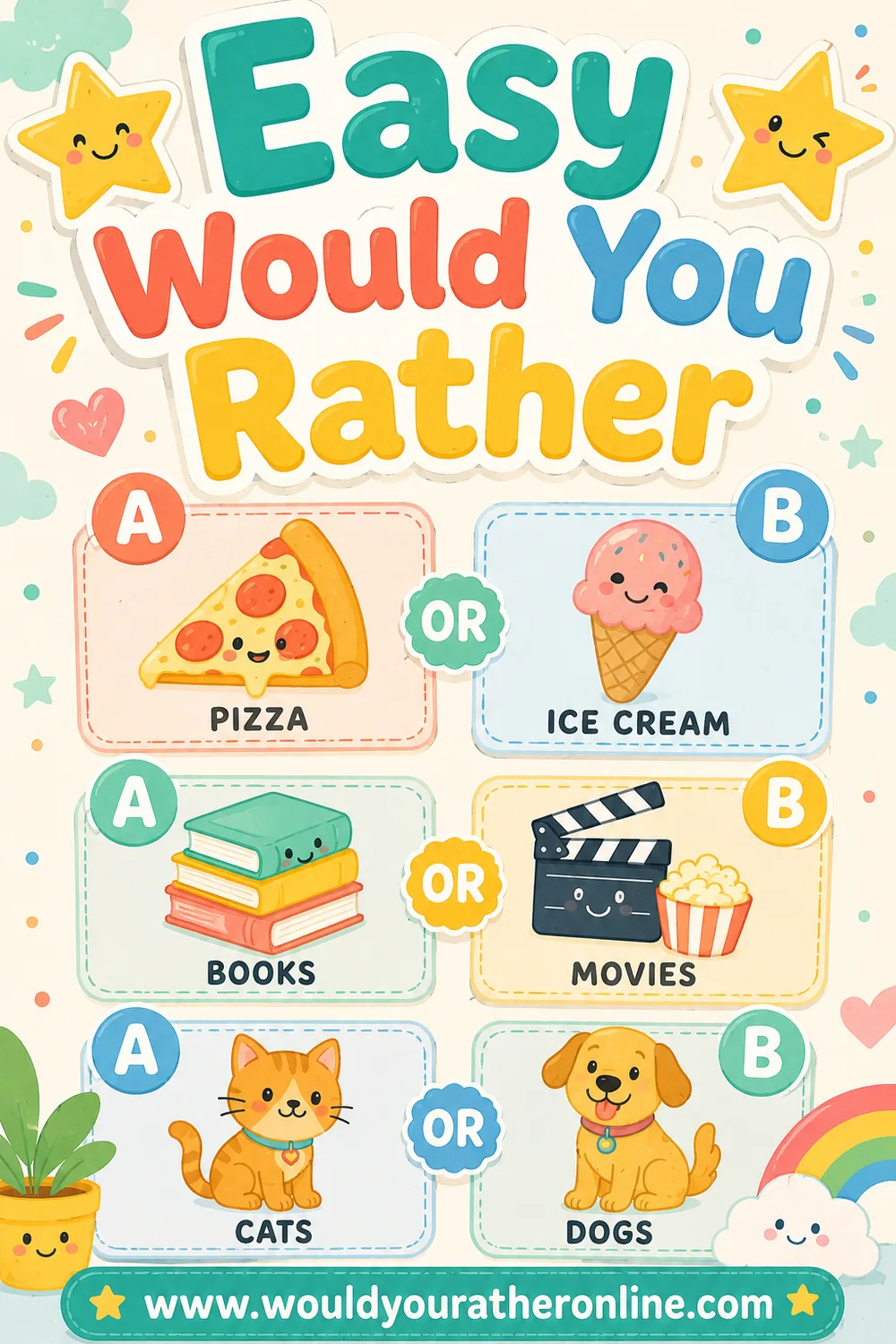
No reading required. You say the two options out loud. That means it works in Kindergarten before anyone can decode a sentence, and it works for the students in your Grade 3 room who would quietly avoid any prompt written on the board. If you like, put a simple picture on each side of the whiteboard, but you don't need to.
It is genuinely fast. A class of 25 gets all the way around the circle in under five minutes when each answer is two words. That matters, because the share is usually the part that runs long and eats the activity. A one-word answer with an optional "because" keeps the whole meeting inside its block, every day, without you having to hurry anyone.
It builds real listening. Because there are only two possible answers, children can actually track the room — and they do. They notice that four people in a row picked the same thing, that their new friend picked the opposite, that the teacher agreed with them. Follow it with "who heard someone choose the same as you?" and you have taught listening without a single reminder to listen.
It is safe for shy students. There is no story to tell about home, no family detail to reveal, no risk of saying the odd thing. A quiet child answers "waffles", the circle nods, and that is a complete, successful, public contribution. Teachers who run this in September consistently report the same arc: the children who whisper their first answers are volunteering reasons by school break. The activity isn't clever — it just makes speaking cheap until speaking becomes normal.
How to Run the Share
Around the circle is the default and the most valuable. You ask the question, then go child by child, each one saying their pick in a clear voice. Everyone speaks, everyone is heard, and the whole thing takes four minutes. Start at a different point in the circle each day so the same child isn't always first or always last — first is exposed, last is a long wait, and rotating fixes both.
Thumbs-up vote is your short version. "Thumbs up for pancakes… thumbs up for waffles." Ninety seconds, no turn-taking, and you still get the shared moment plus a visible result. Use it on assembly days, fire-drill days, and any morning that has already gone sideways. It is also the right choice for the first week with a very young class, before they can hold a turn.
Partner share is the middle path. Children turn to the person beside them, both say their pick and one reason, then you take three or four voices for the whole group. Everyone still speaks — just to one person instead of 25 — which is often the bridge a nervous child needs between voting and taking a turn in the circle.
Use the five-second rule. Say it out loud before you start: each person gets about five seconds, and if you aren't ready, say "pass" and we'll come back to you at the end. Those two sentences are what keep the share to four minutes and what stop a stuck child from becoming the center of attention. Almost every child who passes in the first round answers on the way back round.
Model a good answer first. Take your own turn before the circle starts, and make it exactly the length you want theirs to be: "I'd rather have snow, because I like the quiet." Children copy the model far more reliably than they follow instructions, so if your example is two sentences long, theirs will be too.
Then connect it to the day. The share works best when it hands off into the morning message rather than just ending. "Eleven of us picked leaves — and this afternoon we're going outside to collect some." One sentence, and the share stops being a warm-up and becomes part of the day the class is about to have.
60+ Morning Meeting Questions, Sorted Into 5 Categories
Gentle, familiar and entirely about the school day — perfect for the start of the week, the start of the year, or any morning when the class needs an easy win before anything harder.
- Would you rather start the day with a song or with a story?
- Would you rather have a quiet morning or a busy morning?
- Would you rather sit on the carpet or in a chair for morning meeting?
- Would you rather say good morning with a wave or with a high five?
- Would you rather have art first today or recess first today?
- Would you rather read a book or draw a picture?
- Would you rather do math in the morning or in the afternoon?
- Would you rather have a sunny Monday or a rainy Monday?
- Would you rather line up at the front or at the back?
- Would you rather write with a pencil or with a marker?
- Would you rather have a classroom job you do alone or one you do with a partner?
- Would you rather go first in the circle or last in the circle?
- Would you rather have five extra minutes of reading or five extra minutes of drawing?
The ones that get a laugh out of the circle before 9am. Best for Kindergarten to Grade 3, and reliably the set that gets a reluctant class talking on a gray Tuesday.
- Would you rather have a pet dragon or a pet dinosaur?
- Would you rather hop like a bunny all day or roar like a lion all day?
- Would you rather sneeze bubbles or hiccup glitter?
- Would you rather be as tall as a giraffe or as small as a mouse?
- Would you rather have a bed that bounces or a chair that spins?
- Would you rather wear pajamas to school or wear a cape to school?
- Would you rather sleep upside down like a bat or standing up like a horse?
- Would you rather have a robot that tidies up or a robot that tells jokes?
- Would you rather talk to fish or talk to birds?
- Would you rather ride a giant turtle or a giant frog?
- Would you rather have a door that leads to the beach or a window that shows the moon?
- Would you rather walk backwards all day or tiptoe all day?
- Would you rather live in a treehouse or in a snow fort?
🎮 More Questions in the Game
🎮 Play Would You Rather Free Online — No Download Needed
▶️ Play Free NowThe fastest category in the list, because every child already knows their answer. Both options are always ordinary, everyday foods, so nothing here depends on what is in anybody's lunchbox.
- Would you rather eat pancakes or waffles?
- Would you rather have pizza or spaghetti for lunch?
- Would you rather eat an apple or a banana?
- Would you rather have popcorn or pretzels for a snack?
- Would you rather drink hot chocolate or a fruit smoothie?
- Would you rather have strawberry ice cream or chocolate ice cream?
- Would you rather eat soup or a sandwich on a cold day?
- Would you rather have cheese on everything or ketchup on everything?
- Would you rather try a brand new food or eat your favorite food again?
- Would you rather have breakfast for dinner or dinner for breakfast?
- Would you rather eat crunchy snacks or chewy snacks?
- Would you rather pick the class song or pick the class read-aloud?
These pair naturally with the calendar and weather part of your meeting, so the share flows straight out of what the class has just talked about. Good all year, and especially good on the first snow day.
- Would you rather play in the snow or play in the leaves?
- Would you rather have a beach day or a mountain day?
- Would you rather jump in puddles or jump in a pile of leaves?
- Would you rather build a snowman or build a sandcastle?
- Would you rather see a rainbow or see a shooting star?
- Would you rather have recess in the rain or recess in the wind?
- Would you rather climb a tree or swing on a swing?
- Would you rather go camping or go on a picnic?
- Would you rather watch a sunrise or a sunset?
- Would you rather have summer all year or winter all year?
- Would you rather plant a garden or feed the birds?
- Would you rather ride a bike or ride a scooter?
Still two simple options, but each one quietly points at how the class treats each other. Save these for the days when you want the share to feed directly into your morning message.
- Would you rather give a compliment or get a compliment?
- Would you rather help a friend tidy up or help a friend with their work?
- Would you rather be a great listener or a great storyteller?
- Would you rather make someone laugh or help someone feel calm?
- Would you rather hold the door for the class or hand out the papers?
- Would you rather welcome a new student or show a visitor around the school?
- Would you rather write a thank-you note or say thank you out loud?
- Would you rather work with one partner or with a big group?
- Would you rather share your snack or share your favorite book?
- Would you rather help someone find something they lost or help someone fix something they broke?
- Would you rather start a game or invite someone to join a game?
- Would you rather tidy the classroom together or decorate the classroom together?
- Would you rather be a good teammate or a good leader?
Building It Into Your Routine
Give the week a rhythm. The share works better when children can predict it. A pattern that holds up over a whole year: Monday from the easy-wins list, Tuesday silly, Wednesday food, Thursday seasons, Friday kindness. By October the class knows what kind of question is coming and settles into the circle before you have finished sitting down — which is the entire purpose of a routine.
Let a student choose the question. This is the single upgrade that makes the routine stick. Add "question chooser" to your classroom jobs, print the list, and let the day's chooser pick one and read it to the circle. Suddenly the share belongs to the class rather than to you, and you have created one more small piece of ownership without inventing a new system.
Put an anchor chart on the wall. Two headings, a sentence frame underneath: "I would rather ___ because ___." Younger children point at it while they take their turn; older ones stop needing it within two weeks. It is also the fastest way to get a "because" from a class that has been answering in one word.
Track the votes and turn them into math. Keep a tally on chart paper each morning and by Friday you have five real data sets the class produced about themselves. Kindergarten counts and compares which is more. Grade 2 builds a bar graph. Grades 4 and 5 work out percentages, argue about whether 14 to 11 counts as close, and compare their results against the class next door. Children care about data they generated, and this is the easiest data in the building to collect.
Start a question jar around week six. Once the format is second nature, invite students to write their own questions on slips and drop them in a jar. Skim them before use, obviously, but most will be usable — and a share where the question came from a classmate lands differently. For a wider bank of general classroom uses beyond the circle, see our would you rather questions for the classroom collection.
For Virtual Morning Meetings
On a screen, the two-option format works even better than it does in a room, because the thing that breaks a virtual share is dead air while a child thinks of what to say. There is none of that here.
Use the reactions instead of the circle: thumbs up for option one, clap for option two, and you get a whole-class result in five seconds with nobody unmuting. If your platform has polls, drop the two options in and share the results on screen — children love seeing the bar chart fill up, and it gives you the same tally you would have kept on chart paper.
When you do want voices, call names in a fixed order that you post in the chat first, so every child knows when their turn is coming and can unmute in time. Ask for the answer only, not a reason, or the meeting will run long. And put the two options in the chat as well as saying them, since audio drops out far more often than text does.
🎮 More Questions in the Game
🎮 Play Would You Rather Free Online
▶️ Play Free Now❓ Frequently Asked Questions
What grades is this best for?
Kindergarten through Grade 5, which is exactly the band where morning meeting is most common. Kindergarten and Grade 1 do best with the silly and food categories, where both options are concrete things a five-year-old can picture. Grades 2 and 3 start adding a reason after their answer. Grades 4 and 5 can handle the kindness and community questions and will give genuinely thoughtful answers if you give them room. The questions barely change between grades — what changes is whether you ask for a "because".
How long does the share take?
A class of 25 answering one two-option question around the circle takes about four minutes if you hold to the five-second rule. Add reasons from three or four volunteers and you are at six or seven minutes. If your meeting block is tight, use a thumbs-up vote instead of going around the circle and the whole share is done in under 90 seconds.
Do all students have to answer?
Every child should get the chance, but nobody should be forced. The standard move is to let a student say "pass" and then come back to them at the end of the circle, when they have heard 24 other answers and know exactly what the format sounds like. Most children who pass in September stop passing by October. That gentle second chance is the whole reason a two-option question works better than an open-ended share.
Can I use it for attendance?
Yes, and it is one of the most efficient ways to run a morning meeting. Instead of answering "here" when you call their name, students answer the day's question. You get your register, the class gets a share, and the two routines that used to take six minutes now take four. It also means the first thing every child does each day is speak and be heard, which is the entire point of the share.
Where do I get a new question every day?
There are 60+ on this page, which is roughly three months of school days if you use one a day. When you run out, play the free game on your board and draw a random one, or work through our would you rather question of the day list, which is built for exactly this kind of daily rotation across any group. Many teachers also start letting students submit their own questions to a jar by around week six, and after that the supply problem solves itself.