75+ Would You Rather Questions for Toddlers (Ages 3-5)

📋 Jump to a section
Would you rather questions for toddlers are the rare game that costs nothing, needs no equipment, and works in a car seat, a bath, a doctor's waiting room, or the ten squirmy minutes before dinner is ready. Two choices, one small person, and that's the whole setup.
What looks like a silly time-filler is doing real work. Every question hands your child two words to compare, which is exactly how vocabulary sticks at this age. Every answer is a tiny act of decision-making — a three-year-old choosing between apple slices and banana slices is practicing the same skill they'll use for the rest of their life, just with lower stakes. And because the game runs on turn-taking, they're quietly learning to wait, listen, and answer back.
The catch is that most Would You Rather lists online are written for much older kids. Ask a four-year-old whether they'd rather be invisible or fly and you'll get a blank look, because neither option is a thing they've ever seen. The 75+ questions below are built for pre-readers aged three to five: two real, familiar, picturable things, every time. No reading, no imagining the future, no trick answers.
How to Play With a Toddler (It's Different)
Keep it to exactly two options. This is the rule that matters most. Older kids can juggle a three-way choice; toddlers cannot, and adding a third option usually gets you the last one they heard. Two things, named clearly, one after the other — that's the format their brain can hold.
Use things they can picture. If your child has never seen it, it isn't a choice — it's a noise. Stick to objects, animals, foods, and places that already exist in their week. When you can, point at the real thing or hold up the actual two snacks. A choice you can see beats a choice you have to imagine every single time.
Accept pointing instead of words. Plenty of three-year-olds know their answer long before they can say it. Hold up your left hand for the first option and your right hand for the second, and let them touch, grab, or lean toward the one they want. That's a complete answer. So is a nod, a giggle, or dragging you toward the door.
There are no wrong answers — and don't correct the ones that seem odd. If they say they'd rather have the broccoli than the cookie, the temptation is to say "really?" That one word turns a game into a quiz, and toddlers stop playing games that feel like quizzes. Just say "broccoli! Okay!" and ask the next one.
Expect silly answers, repeats, and total nonsense. They'll answer "banana" six times in a row, pick both, or reply with a dinosaur roar. That's normal, and it's the fun part — at this age the game is really a chance to be silly with a grown-up who's paying attention.
Keep rounds to five minutes. A toddler's appetite for a back-and-forth game runs about five to eight questions before it wanders off. Stop while they're still into it. A short game they loved gets requested again tomorrow; a long one that fizzled doesn't.
What Makes a Good Toddler Question
Concrete beats abstract, always. "Would you rather have a puppy or a kitten?" works. "Would you rather be brave or kind?" does not — not because your child doesn't have those qualities, but because you can't point at them. If an option can't be held, eaten, ridden, hugged, or watched, swap it out.
Familiar beats novel. Grown-ups write questions about exotic things because they're more interesting to grown-ups. Toddlers light up at the ordinary: their own bath, their own park, the specific red cup. The more the question sounds like their actual day, the faster the answer comes.
Both options should be appealing. A choice between something great and something horrible isn't a choice, it's a test with a right answer, and children this age are very good at sensing which one you want them to say. Pair two genuine goods — ice cream or a cookie, the swing or the slide — so the pick is really theirs.
Short sentences, no clauses. Aim for under about a dozen words, with the two options at the end, right next to each other. "Would you rather eat pizza or spaghetti?" lands. A question with a set-up, a condition, and a twist will lose them somewhere in the middle.
75+ Would You Rather Questions for Toddlers, in 6 Categories
The easiest place to start, because every option is something they've tasted. Bonus: you can play this one at the table with the two real things in front of them.
- Would you rather have apple slices or banana slices?
- Would you rather eat pizza or spaghetti?
- Would you rather have a cookie or ice cream?
- Would you rather drink milk or juice?
- Would you rather eat grapes or strawberries?
- Would you rather have pancakes or eggs?
- Would you rather eat cheese or yogurt?
- Would you rather have crackers or pretzels?
- Would you rather eat carrots or cucumber?
- Would you rather have toast with butter or toast with jam?
- Would you rather eat soup or a sandwich?
- Would you rather have popcorn or raisins?
- Would you rather eat noodles with a fork or with a spoon?
Animals are a toddler's favorite subject and their biggest vocabulary bank. Do the sound effects — the noises are half the game at this age.
- Would you rather have a puppy or a kitten?
- Would you rather pet a bunny or a duck?
- Would you rather see an elephant or a giraffe?
- Would you rather hear a lion roar or a cow moo?
- Would you rather have a pet fish or a pet bird?
- Would you rather ride a pony or a bike?
- Would you rather watch monkeys or penguins?
- Would you rather hold a frog or a turtle?
- Would you rather feed the ducks or feed the chickens?
- Would you rather see a butterfly or a ladybug?
- Would you rather have a big dog or a little dog?
- Would you rather hug a teddy bear or a fluffy sheep?
- Would you rather hear a dog bark or a cat meow?
These double as a sneaky way to find out what they actually want to do next — ask two and you've planned the afternoon.
- Would you rather play with blocks or play-dough?
- Would you rather have a red ball or a blue ball?
- Would you rather play with cars or trains?
- Would you rather color with crayons or paint with a brush?
- Would you rather build a tower or knock one down?
- Would you rather pop bubbles or catch balloons?
- Would you rather cuddle a teddy bear or a doll?
- Would you rather do a puzzle or read a book?
- Would you rather play with sand or water?
- Would you rather bang a drum or shake a bell?
- Would you rather wear a silly hat or a cape?
- Would you rather play outside or play inside?
- Would you rather play hide and seek or chase?
Built for the car, the stroller, and the walk to daycare. Every option is a place or a ride they already know.
- Would you rather go to the park or the beach?
- Would you rather ride in a car or on a bus?
- Would you rather go to the zoo or the playground?
- Would you rather swing or go down the slide?
- Would you rather visit Grandma or go to the store?
- Would you rather splash in a puddle or a pool?
- Would you rather ride a train or a boat?
- Would you rather go to the library or a farm?
- Would you rather walk or ride in the stroller?
- Would you rather go to a birthday party or the ice cream shop?
- Would you rather see a big airplane or a big truck?
- Would you rather play in the rain or in the snow?
🎮 More Questions in the Game
🎮 Play Would You Rather Free Online — No Download Needed
▶️ Play Free NowThe most useful category of the six. Slipping a real choice into bath time or getting dressed gives a toddler a scrap of control, which is often all it takes to skip the standoff.
- Would you rather have a bath or a shower?
- Would you rather wear shoes or rain boots?
- Would you rather brush your teeth first or put pajamas on first?
- Would you rather have bubbles in the bath or toys in the bath?
- Would you rather sleep with a blanket or a teddy?
- Would you rather have a bedtime story or a bedtime song?
- Would you rather wear a red shirt or a blue shirt?
- Would you rather put on socks or slippers?
- Would you rather sit in the big chair or the little chair?
- Would you rather help sweep the floor or wipe the table?
- Would you rather have a big hug or a high five?
- Would you rather sleep with the light on or the light off?
Save these for last — they get the biggest laughs, and every single one can be acted out. Pretending is where three-to-five-year-olds do their best thinking.
- Would you rather be a lion or a mouse?
- Would you rather hop like a bunny or stomp like an elephant?
- Would you rather wear a funny hat or funny glasses?
- Would you rather wear pajamas all day or shoes on your hands?
- Would you rather have a purple nose or green hair?
- Would you rather fly like a bird or swim like a fish?
- Would you rather be very tall or very tiny?
- Would you rather play with a dinosaur or a robot?
- Would you rather sing very loud or whisper very quiet?
- Would you rather dance like a monkey or wiggle like a worm?
- Would you rather have a tail or big floppy ears?
- Would you rather live in a treehouse or a castle?
Turning It Into a Learning Moment
Ask "why?" — once. The question itself takes one word to answer; the "why" is where the language happens. You'll get answers like "because it's crunchy" or "because it's my favorite color," and those little sentences are worth more than the pick was. One why per question is the sweet spot — a second one starts to feel like an interrogation, and they'll shut down.
Count the votes. With more than one player, count the hands out loud. "Two for the puppy, one for the kitten — two is more!" That's early math hiding inside a game: counting, comparing, and the words more and less attached to something they can see.
Act the answers out. Whatever they pick, do it. They chose the elephant? Stomp around the kitchen. They chose the bunny? Hop to the bathroom for teeth. Movement locks the word in, burns off energy, and it's what makes the silly category land so well — the acting is the reward.
When They're Ready for More
Somewhere around five or six, the answers stop being instant and start arriving with reasons, arguments, and follow-up questions attached. That's your sign that concrete pairs have stopped being a challenge and it's time for real scenarios.
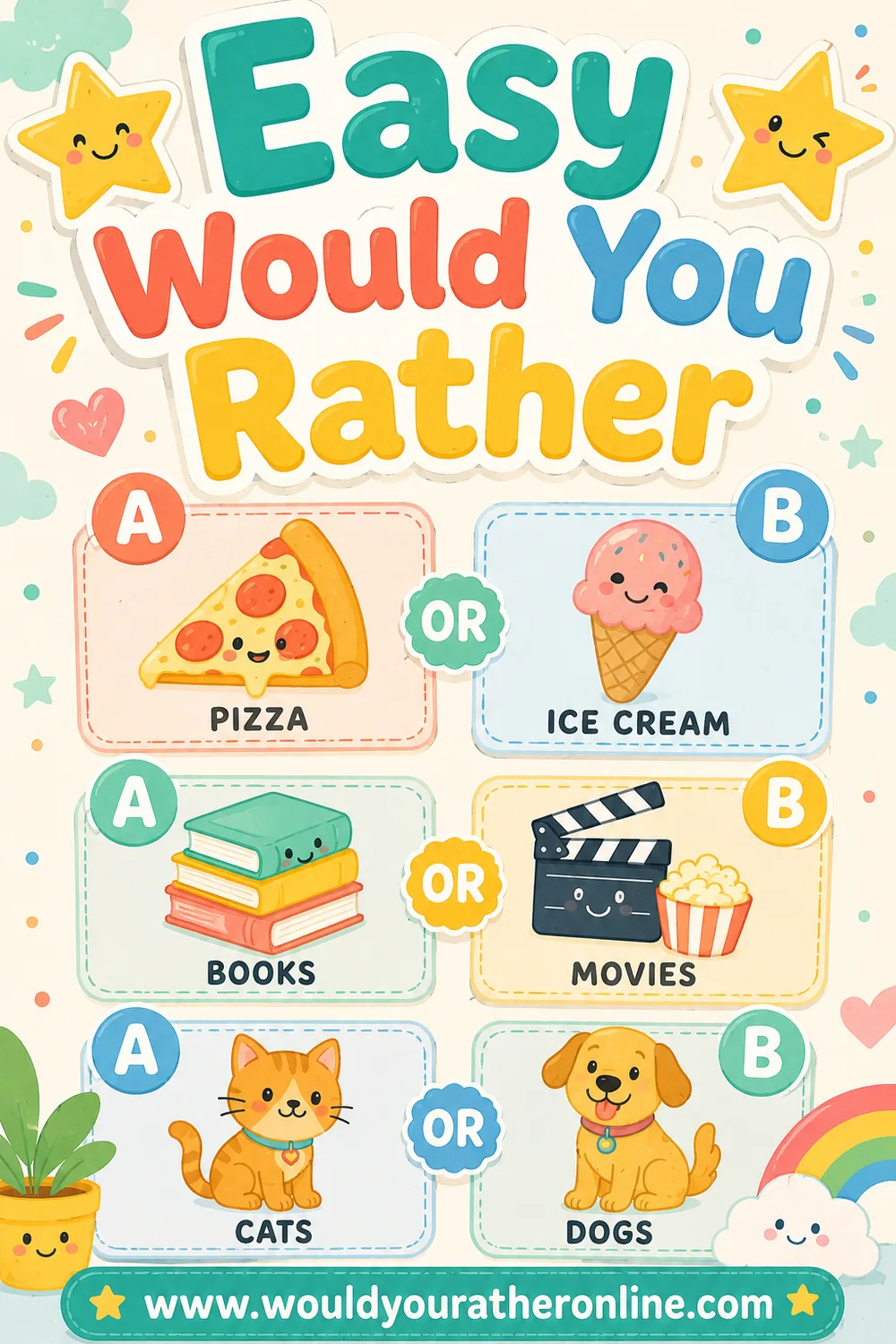
When you get there, the next stop is 150+ Would You Rather questions for kids, written for ages six to twelve, where the questions can finally involve superpowers, trades, and consequences. If you want something in between for a mixed-age group — a five-year-old and a nine-year-old in the same car — easy Would You Rather questions are short enough for the little one and still fun for everyone else. And when the whole family is in, you can play the free Would You Rather game right here and see how your picks compare to everyone else's.
🎮 More Questions in the Game
🎮 Play Would You Rather Free Online
▶️ Play Free Now❓ Frequently Asked Questions
What age can a toddler start playing Would You Rather?
Most children can join in around age three, once they can name a handful of familiar objects and understand the word "or." Some two-and-a-half-year-olds manage it by pointing instead of talking, which counts. If your child answers by repeating the last thing you said, they're not ready for choices yet — play again in a month or two and it usually clicks.
What if my toddler picks both options, or neither?
Let them. "Both" and "neither" are perfectly good answers at this age, and correcting them turns a game into a test. If you want to nudge them toward choosing, hold up one hand for each option and ask them to touch the one they want — the physical version of the question is much easier to answer than the spoken one.
How long should a round last with a toddler?
Five minutes is plenty, and three is fine. A toddler's attention for a back-and-forth game runs roughly five to eight questions before it drifts. Stop while they're still enjoying it — that's what makes them ask to play again in the car tomorrow.
Are these questions good for preschool circle time?
Yes, and they work especially well as a group vote. Read one question, name each option, and have children raise a hand or move to one side of the rug. It gives every child a turn to participate without needing to speak, it takes under a minute per question, and counting the two groups doubles as an early math activity.
Is this really a screen-free game?
Completely. There's nothing to print, buy, charge, or set up — you just need the questions in your head. That's why it works in the places screens are awkward: car seats, waiting rooms, restaurant queues, the bath, and the ten minutes before bed.