The Hardest Would You Rather Questions (And Why They Work)
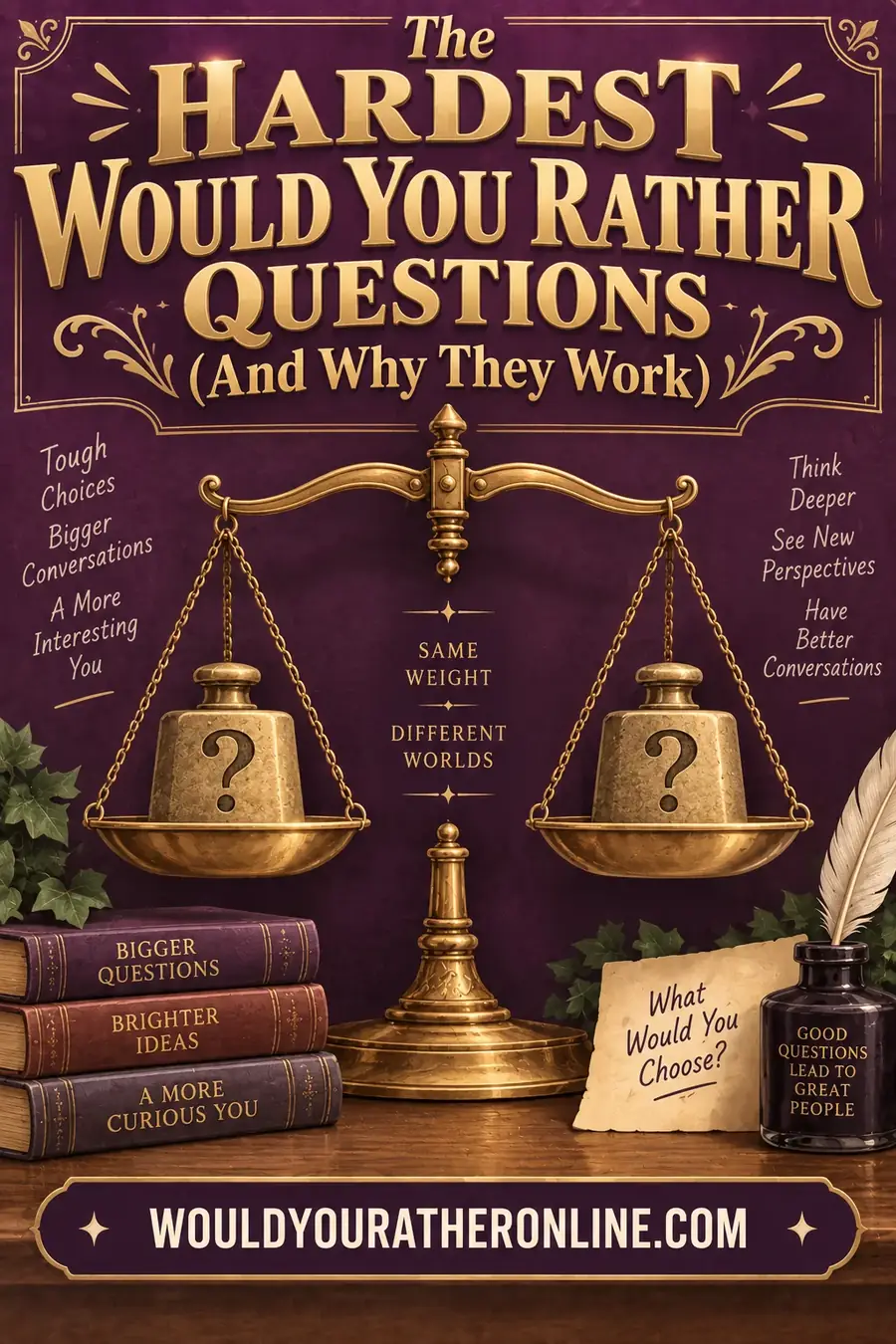
A genuinely hard would you rather question isn't one where both options are awful — it's one where both options are appealing, and choosing means giving up something you actually want. Anyone can make a question difficult by making both sides horrible. That produces a wince, not a dilemma.
The hard ones make you argue with yourself.
What Makes a Question Actually Hard
Both options have to be genuinely defensible. If a reasonable person could pick either and explain why, it's a real dilemma. If everyone picks the same side, it's a poll.
The trade-off has to be between different kinds of good. Money vs. time. Security vs. freedom. Being known vs. being left alone. You can't compare them on a single scale, which is exactly why they're hard.
The stakes have to feel real. Abstract hypotheticals about magic powers are fun but easy. Questions about how you'd actually live are harder because you have to consult what you actually value.
There must be no escape hatch. The moment someone can answer "well, I'd just do X instead," the question deflates.
Life and Values
- Would you rather know exactly when you'll die, or exactly how?
- Would you rather have a job you love that barely pays, or a job you tolerate that pays extremely well?
- Would you rather be respected by everyone and loved by no one, or loved by a few and thought little of by everyone else?
- Would you rather live 40 more years in perfect health, or 70 in declining health?
- Would you rather always know when someone is lying to you, or always be believed when you lie?
- Would you rather be able to change one decision in your past, or see one decision in your future?
- Would you rather never feel physical pain again, or never feel emotional pain again?
- Would you rather be forgotten entirely after you die, or remembered for one thing you're not proud of?
Relationships
- Would you rather your closest friend told you a hard truth that damaged your friendship, or kept a comfortable lie that preserved it?
- Would you rather be the person who loves more, or the person who is loved more?
- Would you rather know every thought of the person closest to you, or have them know every thought of yours?
- Would you rather lose contact with your five closest friends, or with your entire extended family?
- Would you rather be genuinely understood by one person, or genuinely liked by hundreds?
- Would you rather find out a happy memory was false, or forget it entirely?
Money and Work
- Would you rather work four days a week for 25% less pay, or five days for what you earn now?
- Would you rather receive $10 million today on condition you never work again, or keep your career with no windfall?
- Would you rather have complete job security in work you find meaningless, or precarious work you find meaningful?
- Would you rather your salary was public to everyone you know, or you could never discuss money with anyone again?
- Would you rather be the least skilled person on an excellent team, or the most skilled on a mediocre one?
Knowledge and Truth
- Would you rather know the answer to any one question, or be able to ask any one person one question they must answer honestly?
- Would you rather know every historical event exactly as it happened, or know how the next hundred years unfold?
- Would you rather all your private thoughts from the last year became public, or you lost all memory of that year?
- Would you rather be certain of an uncomfortable truth, or hopeful in useful uncertainty?
Fantasy With Real Costs
The good version of the hypothetical category — every power has a price attached.
- Would you rather be able to fly but never travel by any other means, or teleport but only to places you've already been?
- Would you rather live forever while everyone you know ages normally, or age normally in a world where everyone else lives forever?
- Would you rather relive your best year on loop for a decade, or experience ten completely new but ordinary years?
- Would you rather be able to undo any one action per day, or know the outcome of any one action before taking it?
- Would you rather speak every language but never write, or read every language but never speak?
Running a Hard Round
Hard questions need different handling from casual ones.
Fewer questions, more time. Five hard questions in an hour beats twenty. The value is in the discussion, not the throughput.
Require the reasoning. The answer alone is nearly worthless — "money" tells you nothing. The why is the entire content.
Let people change their minds. A hard question should be able to move someone after they hear an argument. Allowing revision is what turns it into a conversation rather than a survey.
Don't push for consensus. The point is discovering that reasonable people diverge, not settling on an answer.
Read the room on depth. These work with people who know each other and want to talk. They'll die at a loud party or with a group that wants light entertainment — that's what the easier categories are for.
Watch for genuinely sensitive ground. Questions about death, health, family and regret land differently depending on what someone is currently living through. Have a way to skip without explanation.
Writing Your Own Hard Questions
Start with a real tension you've thought about — a trade-off you've actually faced or watched someone face. Then strip it down to two options with no middle ground and no escape.
Test it on yourself first. If you can answer instantly and confidently, it isn't hard. If your answer changes depending on your mood, or you find yourself still thinking about it an hour later, you've written a good one.
A would you rather generator is useful for mixing difficulty levels across a session, since a full hour of heavy questions exhausts most groups.
More Difficult Questions
Time and mortality: - Would you rather live one life of 200 years or five lives of 40 years, each with no memory of the previous? - Would you rather be able to pause time but age normally while paused, or rewind an hour once a day? - Would you rather know the date of your death or the manner of it? - Would you rather spend your last year knowing it, or die suddenly with no warning?
Identity and self: - Would you rather lose all your memories but keep your personality, or keep every memory but lose your personality? - Would you rather be the version of yourself you were ten years ago, or the version you'll be in ten years? - Would you rather everyone see you exactly as you see yourself, or see yourself exactly as everyone else sees you? - Would you rather be permanently misunderstood but respected, or accurately understood and disliked?
Success and cost: - Would you rather achieve your greatest ambition and know it was luck, or narrowly fail and know you deserved better? - Would you rather be excellent at something nobody values, or mediocre at something everyone does? - Would you rather be the best in your field for one year, or top ten for thirty? - Would you rather have your work outlive you anonymously, or be famous for something you didn't make?
Ethics and choice: - Would you rather always tell the truth or always be told the truth? - Would you rather prevent one certain death you'd witness, or a hundred statistical ones you'd never know about? - Would you rather be able to forgive anything, or be forgiven anything?
How to Run These With a Group
Fewer questions, longer on each. Five in an hour is right. The value is in the discussion.
Insist on the reasoning. The bare answer carries almost no information. Ask "why" every time and don't accept "I just would."
Let people change their minds. A genuinely hard question should be able to move someone. Allowing revision converts a poll into a conversation.
Don't chase agreement. The point is discovering that reasonable people diverge, not settling on a group answer.
Watch the register. These need a group that knows each other and wants to talk. In a loud room or with people who want light entertainment, they die completely.
Make skipping easy. Questions about death, health, family and regret land unpredictably depending on what someone is currently living through. A no-explanation-needed skip should be established before you start.
Writing Your Own
The method that produces genuinely hard questions rather than merely unpleasant ones.
Start from a real tension. Not a random pairing — an actual trade-off you've faced or watched someone face. Money against time. Security against freedom. Being known against being left alone. Honesty against kindness.
Make both options genuinely appealing. If one is clearly worse, it isn't a dilemma. The test is whether a reasonable person could choose either and defend it.
Close the escape routes. Any answer beginning "well, I'd just..." means the question has a leak. Add the constraint that closes it.
Make it concrete. "Would you rather be rich or free?" is abstract and produces abstract answers. "Would you rather earn triple your salary working sixty hours a week, or half your salary working twenty?" is answerable.
Test it on yourself. If you can answer instantly and confidently, it isn't hard. If your answer changes depending on your mood, or you're still thinking about it an hour later, you've written a good one.
Keep it under two lines. A question that needs a paragraph of setup loses the room before the choice arrives.
Question Categories That Reliably Produce Difficulty
Trade-offs between different kinds of good. Money and time. Fame and privacy. Certainty and possibility. These are hard because the two things can't be compared on a single scale.
Questions about self-knowledge. Would you want to know how others see you? Would you want to know your own future? People genuinely split on these and the reasoning reveals a lot.
Questions with a hidden cost. A power that comes with a price. A gain that requires a loss. The best fantasy questions all work this way.
Questions about other people. Anything involving loyalty, honesty or obligation to someone else tends to be harder than questions about yourself alone.
Questions where the answer changes with age. Many of these land differently for someone at twenty and someone at sixty, which makes them excellent in a mixed-age group.
For lighter questions and the general principles of what makes any would-you-rather work, see what is a good would you rather.
Thoughtful, Diabolical, or Dark: Three Different Kinds of Hard
"Hard" covers three registers that behave very differently in a room, and mixing them up is what turns a good round flat.
Thoughtful. Would you rather questions that make you think are built on a genuine values trade-off with no comic escape hatch — knowing the date of your death or not, keeping a memory or losing a regret. They produce the longest answers and the best conversations, and they need a group willing to sit with a pause. Most of the questions in the lists above sit here.
Diabolical. The most diabolical would you rather questions are hard by construction rather than by subject. Both options are engineered to be unbearable in the same way, so the usual escape routes are closed: any choice you make convicts you of something. These are enormously fun in a competitive group and exhausting in a large one, so use two or three, not ten.
Dark humor. A dark humor would you rather trades on discomfort for a laugh rather than a decision, and it is the register with the shortest reach. It works in a group of close friends who share a sense of humor and fails badly with strangers, coworkers, or anyone whose personal experience you cannot know. Read the room before, not after — and if you are running the round for a mixed group, leave this category out entirely rather than testing it.
❓ Frequently Asked Questions
What makes a would you rather question hard rather than just unpleasant?
Hard questions have two genuinely appealing options, so choosing means losing something you want. Unpleasant questions have two bad options, which produces a wince rather than a real dilemma.
How many hard questions should I use in one session?
Five or so across an hour. These are for discussion rather than throughput, and a full session of heavy questions tends to exhaust a group rather than engage it.
Should people be allowed to change their answer?
Yes. A genuinely hard question should be able to shift someone once they've heard a good argument — allowing revision is what turns it into a conversation instead of a poll.
Are hard would you rather questions suitable for any group?
No. They need a group that knows each other reasonably well and wants to talk. In a large, loud or casual setting they fall flat, and questions touching death, health or regret should always be skippable without explanation.
🎲 Want to switch games? Learning party games? See how to play Never Have I Ever — the natural companion to Would You Rather.