10 Best Games Like Would You Rather (Free to Play)
📋 What's in this guide
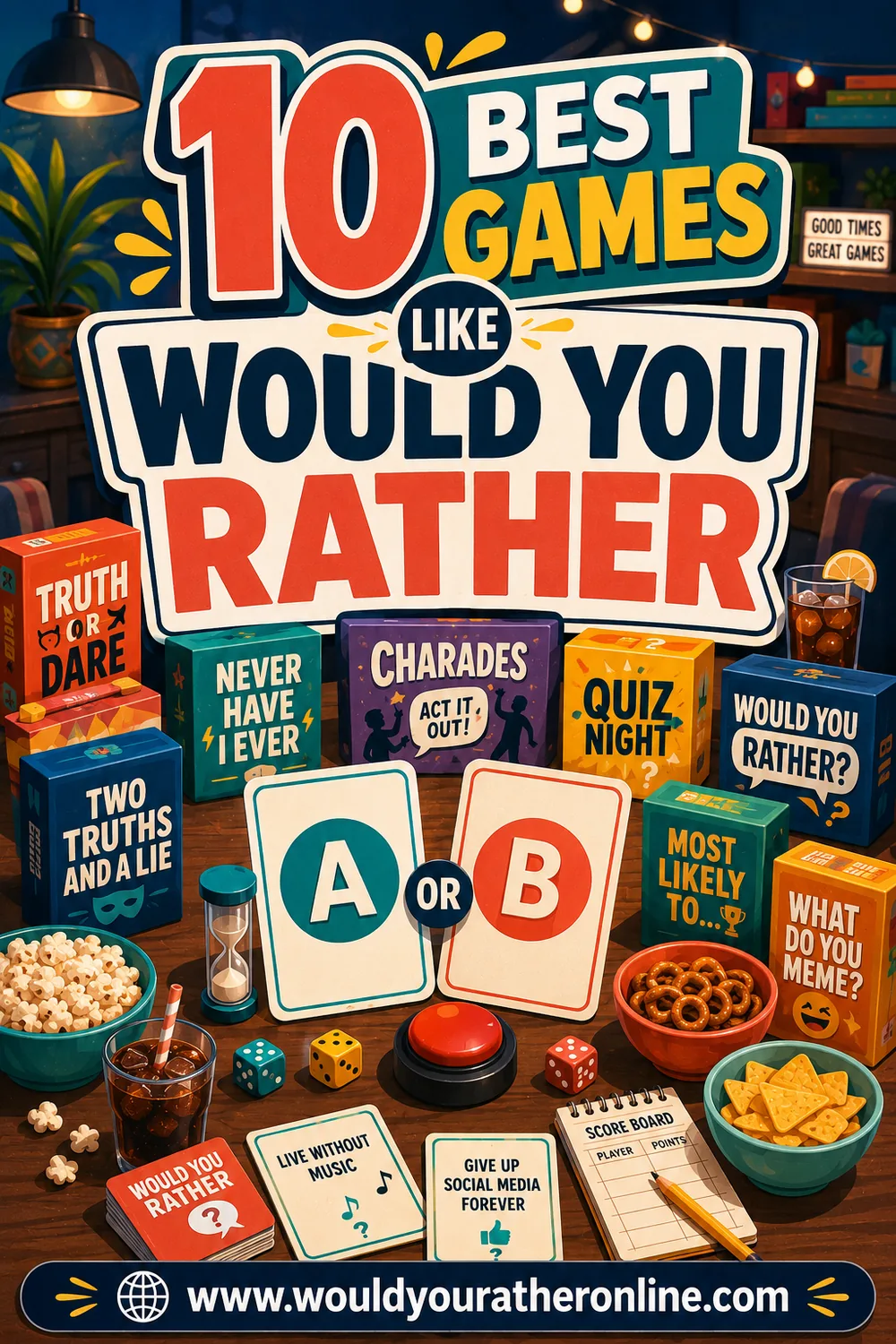
There comes a point on every good night when the group has burned through every question you can think of and somebody says, "okay, what else?" That's what this page is for. These are ten games like Would You Rather — party games that need nothing but people, no board, no cards, no batteries, no app.
Every game here is a traditional, played-out-loud one that's been passed around campfires, car back seats and school buses for decades. Nobody owns them, so nobody has to buy anything. Four people and twenty minutes is the entire equipment list.
For each one you'll get the same four things: what it is, how to play it, the group size it actually suits, and why it works as a follow-on when Would You Rather has run its course. After that there's a quick guide to picking the right game for your situation, and a few tricks for keeping any of them alive past the ten-minute mark.
1. Never Have I Ever
What it is: a confession game. Instead of choosing between two futures, you find out what people have already done.
How to play: everyone holds up five fingers. Round the circle, each player says "never have I ever—" and finishes with something they genuinely haven't done. Anyone who has puts a finger down, then explains themselves. Last finger up wins.
Best group size: 4–10 — big enough that somebody always goes down, small enough to hear every story.
Why it follows on well: same circle, same "wait, really?" energy, swapping hypothetical choices for real ones. If you're weighing up the two, we compared them in Would You Rather vs Never Have I Ever.
2. This or That
What it is: Would You Rather with the brakes off. Two options, no scenario, no explanation — just pick. Coffee or tea. Beach or mountains. Text or call.
How to play: one person fires the pairs at the group as fast as they can read them, and everyone answers instantly. No thinking time, no justifying yourself; hesitate two seconds and the group moves on without you. Fifty pairs in five minutes is normal.
Best group size: 2 to as many as you like — the one game here that genuinely doesn't care.
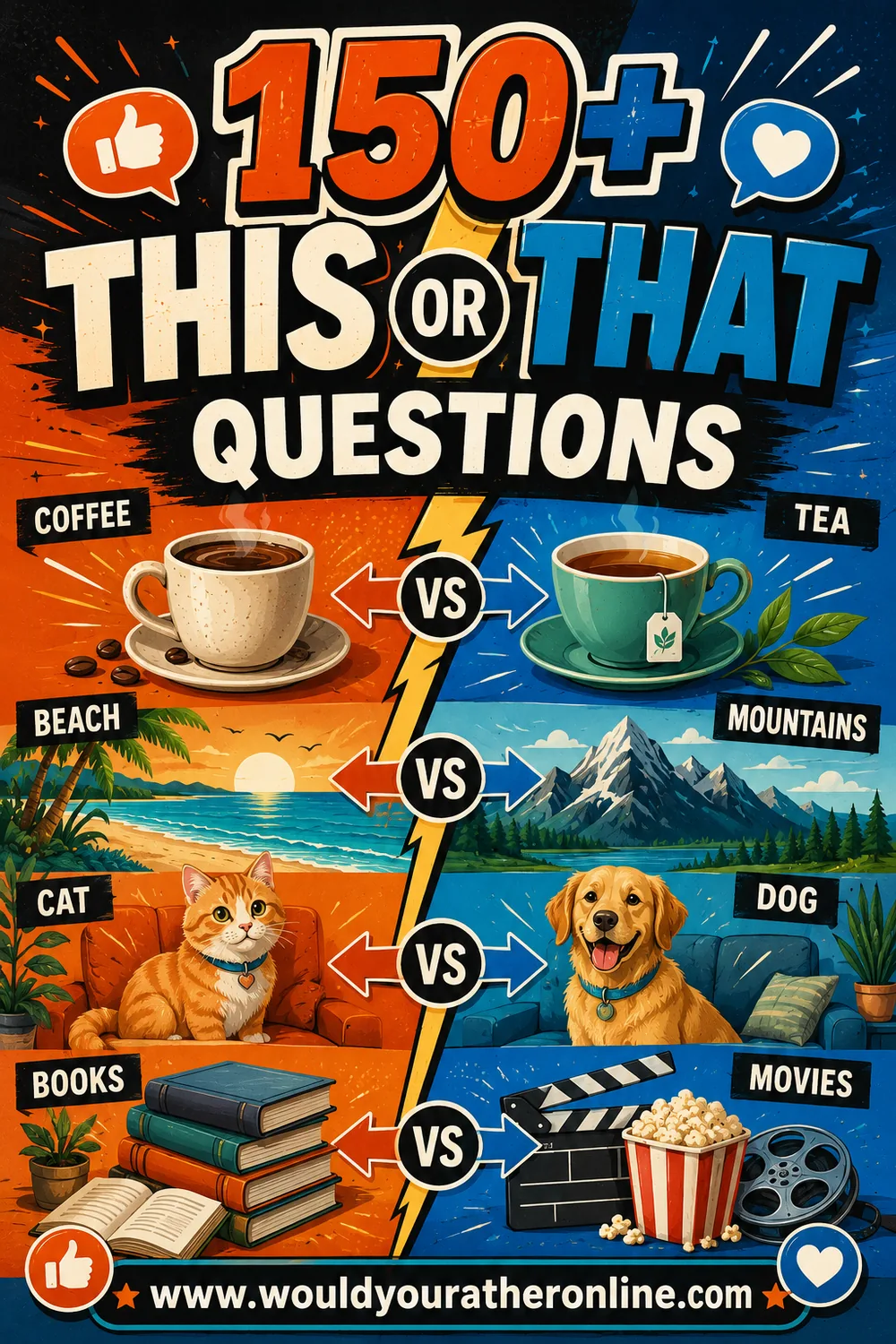
Why it follows on well: it's the palate cleanser for when a Would You Rather debate has run long and the room needs a change of speed. Take a ready-made list from our 150+ This or That questions.
3. Two Truths and a Lie
What it is: the icebreaker that actually works. One player makes three statements about themselves; the group works out which is invented.
How to play: on your turn, say three things about yourself — two true, one false — in the same flat tone, so nothing gives you away. Everyone votes on which is the lie, then you reveal. Score a point per person fooled, and a point for every lie you spot on someone else's turn.
Best group size: 4–8. Past ten players the turns drag, because each round is one person at a time.
Why it follows on well: Would You Rather tells you how someone thinks; this tells you what they've actually done. It's the best of the ten for a group that doesn't know each other yet.
4. Most Likely To
What it is: a game about the group's opinion of itself. Somebody reads a prompt, everyone points, and whoever gets the most fingers aimed at them defends their reputation.
How to play: read out "who's most likely to—" followed by anything: miss a flight, adopt six cats, cry at an advert. On three, everyone points at one person, and most votes wins the title. Keep it affectionate rather than cutting, and give the accused thirty seconds of defense.
Best group size: 5–30. The best big-group game here, because everyone answers simultaneously.
Why it follows on well: zero setup and no turn order, so it's the easiest game to start mid-party when Would You Rather has stalled and half the room has drifted to the kitchen.
🎮 Play the Original Free
🎮 Before you move on — hundreds of fresh Would You Rather questions, free and no download
▶️ Play Free Now5. Truth or Dare
What it is: the oldest party game in the book, and the only one here with a physical component — each player picks between answering honestly and performing a challenge.
How to play: round the circle, the player whose turn it is picks "truth" or "dare," and the person to their left sets it. Agree two rules first — nothing that leaves the building, and anyone may pass once — and it stays fun instead of tense.
Best group size: 4–12, and best with people who already know each other.
Why it follows on well: it's the escalation. Would You Rather is safe by design; this raises the stakes for a group that's warmed up. Play it late in the night, never first.
6. 20 Questions
What it is: a guessing game of pure deduction. One player thinks of something; everyone else has twenty yes-or-no questions to figure out what it is.
How to play: the thinker picks a person, place, or object and says which of the three it is. The group asks questions answerable only yes or no — "is it alive?", "is it bigger than a car?" — each counting against the twenty. Guess in time and the group wins; run out and the thinker scores.
Best group size: 2–8, and one of the very few here that's genuinely excellent with just two players.
Why it follows on well: it's the quiet one. After a loud round of arguing, this drops the volume and gives the group a shared puzzle instead of a split — exactly what you want in hour three of a car journey.
7. Hypotheticals (What Would You Do?)
What it is: Would You Rather without the two options. One scenario, an open field: what would you actually do?
How to play: someone poses a situation — you find a wallet stuffed with cash, you can send one text to yourself ten years ago, you get a day with no consequences. Everyone answers in turn, then comes the good bit: the group interrogates the answers. No scoring; it ends when the conversation moves on.
Best group size: 3–8. Any bigger and people stop getting airtime to explain themselves.
Why it follows on well: it's the deep end of the same pool. If your group keeps saying "neither" or inventing a third option, they want this game instead. Start with our 100+ hypothetical questions.
8. The Story Game (One Word at a Time)
What it is: a group storytelling game where nobody is in charge of the plot. The story is built one word at a time around the circle, and always ends up somewhere ridiculous.
How to play: the first player says one word, the next adds one word, and round it goes, building sentences nobody planned. Two house rules make it much better: say your word within three seconds, and never say "and" twice in a row. Stall and you're out.
Best group size: 4–12. Works in a circle, a car, or a call if you agree the speaking order first.
Why it follows on well: it's the one game here that's creative rather than confessional — ideal when a group has revealed quite enough about themselves for one evening.
9. Fortunately / Unfortunately
What it is: a storytelling game on a see-saw. Every sentence flips the hero's fortunes, and the group tries to out-do each other on the swings.
How to play: player one starts with a "fortunately" sentence — fortunately, we found a boat. Player two replies with an "unfortunately" — unfortunately, it had no bottom. Keep alternating round the circle. The trick: each twist must follow from the last, not simply undo it.
Best group size: 3–10, and superb with mixed ages, because children are frequently better at it than adults.
Why it follows on well: it's the gentlest game here. Nobody is put on the spot about themselves, so it works with in-laws, new colleagues, and anyone who found Never Have I Ever a bit much.
10. Categories (Beat the Timer)
What it is: a rapid-fire word game. Someone names a category, players take turns naming things that fit, and it runs until somebody blanks.
How to play: pick a category — breakfast foods, countries in Europe, things in a toolbox. Set a phone timer for five seconds and pass it round; each player names one new item before it goes off, and repeats don't count. Whoever gets caught is out, and a fresh category starts.
Best group size: 3–20. It scales up better than almost anything here, because eliminated players stay involved as hecklers.
Why it follows on well: it's the adrenaline option. Would You Rather rewards thinking slowly; this punishes it, so it wakes up a room that's gone sleepy after a long debate.
Which Game Should You Pick?
Ten options is nine too many when everyone's waiting on you. Here's the shortcut, by situation.
🚗 In the car
Nothing with pointing or props — the driver needs their eyes on the road. 20 Questions is the classic for a reason; it can run forty minutes on a single object. Follow it with Fortunately / Unfortunately, which needs no turn order beyond "whoever speaks next."
🎉 At a big party
Anything with individual turns dies past fifteen people. Go with Most Likely To, where everyone answers at once, or Categories, where elimination keeps the crowd watching. Both work standing up, drink in hand, with people wandering in and out.
🧒 With kids
The Story Game and Fortunately / Unfortunately are the winners — silly, safe, nothing personal. Categories doubles as sneaky vocabulary practice. Save Never Have I Ever and Truth or Dare for the grown-ups.
💑 For couples
Two players kills most party games, but not these. 20 Questions is built for a pair, and Hypotheticals is the one that actually goes somewhere — you learn more from one honest "what would you do" than from an hour of small talk.
💼 As a work icebreaker
Two Truths and a Lie is the safest choice by a distance: everyone controls exactly how much they share, and it gives new starters an instant fact to be remembered by. This or That is the five-minute version when the meeting's already running late.
💻 On a video call
Lag ruins anything needing quick reflexes, so skip Categories. Two Truths and a Lie and Most Likely To both work beautifully, because people vote in the chat and read the results at once instead of shouting over each other.
How to Keep Any of Them Going
Mix two games instead of playing one. Every game here starts brilliantly and sags after about fifteen minutes. The fix isn't a better game, it's a shorter one: run ten minutes of Would You Rather, switch to Most Likely To, then come back. Groups remember five short games far more fondly than one long one.
Use the follow-up rule. This one rule doubles the life of all ten: after anyone answers, the person to their left must ask a follow-up. "Why?" counts. It turns a list of answers into an actual conversation — the reason some groups get a whole evening out of twelve prompts while others burn a hundred in twenty minutes.
Let the quiet people set the prompts. If one person does all the reading, they're playing a different game to everybody else. Pass the question-asking round with the turns; the shyest player often writes the best prompts.
Stop while it's still good. The best game night ends one round before people want it to. When you hear the first "okay, last one" — that was the last one. Finish there and the group will ask for the same games next time.
🎮 Ready to Play?
🎮 Start with the original — Would You Rather, free online, no sign-up and no download
▶️ Play Free Now❓ Frequently Asked Questions
Which game like Would You Rather is best for a big group?
Most Likely To and Categories. Most Likely To works because everyone points at once, so a room of thirty answers in three seconds rather than thirty turns. Categories works because elimination keeps a crowd watching even when it isn't their turn. Avoid Two Truths and a Lie with a big group — it needs a full turn per person.
Which of these games is best for kids?
The Story Game, Fortunately / Unfortunately, Categories, and 20 Questions. All four are silly rather than personal, and nobody has to reveal anything about themselves. Skip Never Have I Ever and Truth or Dare with children unless you write the prompts yourself, since both are usually played with adult material.
Do any of these games need equipment?
No. Every game here is a traditional party game played entirely out loud, so people are the only requirement. A phone timer helps for Categories and paper makes scoring easier in Two Truths and a Lie, but both are optional. That's what makes these the natural companions to Would You Rather in a car, a queue, or a campsite.
Which game is closest to Would You Rather?
This or That is closest by structure — the same two-option choice with the debate stripped out, so it plays about four times faster. Never Have I Ever is closest by feel, since both are about learning something surprising about the people in the room.
Can I play these games online?
All ten work on a video call or in a group chat, because none need a board, a buzzer, or people in the same room. Would You Rather itself you can play free on this site, with a deck that shuffles without repeats and live vote percentages a spoken game can't give you. For the other nine, one person reads the prompts aloud.