How to Play Would You Rather: The Complete Guide (All Rules, Formats & Tips)
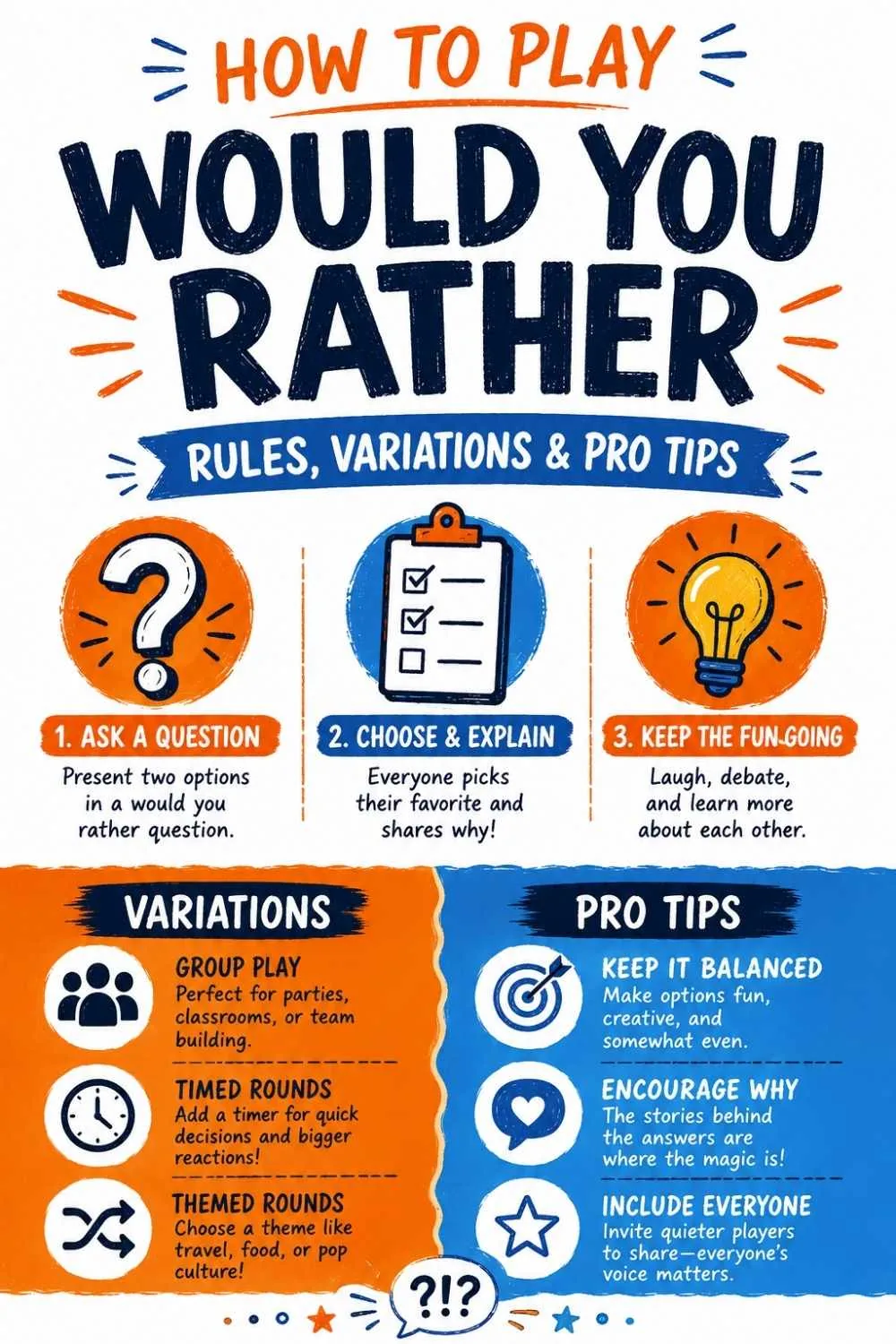
Would You Rather has no complicated rules, no board to set up, no cards to deal, and no equipment to buy. It's one of the most widely played conversation games in the world, and you can start playing it right now with no preparation at all.
But there's a significant difference between a round of Would You Rather that produces quick answers and moves on, and a round that creates genuine conversation, unexpected insights, and the kind of game people are still talking about hours later.
This guide covers everything: the basic rules, every major format, tips for every type of group, how to make any round more interesting, and what separates the questions that land from the ones that don't.
The Basic Rules of Would You Rather
The core game is as simple as it gets:
- One person asks a question — "Would you rather [Option A] or [Option B]?"
- Everyone picks one option — You must choose. You cannot say "neither" or "it depends."
- Players explain their choice — This part is optional in the basic version, but almost always produces the best content.
- The asker answers too — Everyone plays, including the person asking.
That's the complete basic ruleset. Everything else is a variation.
The One Unbreakable Rule
You must choose one. The entire game is built on forced choice — the constraint is what makes it interesting. "It depends" removes the constraint and removes the game. "I can't decide" is a valid feeling, but the game requires you to decide anyway. Sometimes the impossibility of the choice is the point.
The 5 Most Popular Would You Rather Formats
1. Standard / Casual
Best for: Small groups, dinner conversation, road trips, hanging out with friends.
One person reads a question. Everyone answers. The person who asked answers last (or first — both work). If an answer is interesting, the group asks a follow-up question. Move on when you're ready.
No scoring, no timer, no elimination. Just answers, reasoning, and conversation. This is the most common format and the one that produces the best conversations.
How long it takes: As long as you want. One question can last 30 seconds or 30 minutes depending on how interesting the answer is.
2. Speed Round
Best for: Parties, large groups, high-energy settings, warm-up for a longer game.
A designated host reads questions as fast as possible. Everyone answers simultaneously — show a hand for A, keep hands down for B (or use any instant signal your group decides). No discussion in the speed round — just answers.
After 20-30 speed round questions, go back to the most divisive ones (the ones with close splits) and have a proper discussion round.
How long it takes: 20 questions in about 5 minutes. The discussion round after is variable.
3. Prediction Mode
Best for: Close friend groups, couples, families, groups that know each other well.
Before each person answers, everyone else writes down (or says quietly) what they think that person will choose. Then the person reveals their answer. Anyone who predicted correctly gets a point. Play 10-15 questions; whoever has the most correct predictions wins.
The power of this format: being wrong about someone's answer is usually more interesting than being right. "Wait, I would have bet anything you'd say A — why did you say B?" is where the best conversations start.
How long it takes: 30-45 minutes for a full round with discussion.
4. Debate Mode
Best for: Groups that love arguing, classrooms, teams, any context where intellectual engagement is the goal.
After everyone answers, split into two groups based on choice: everyone who chose A defends A, everyone who chose B defends B. Each group has two minutes to build their argument. Then groups present. The group with the better argument wins — as voted by a neutral judge or by majority.
Note: You're arguing for the option you chose, not necessarily the one you'd choose if you were thinking more carefully. The constraint produces more interesting arguments.
How long it takes: 10-15 minutes per question. Use this format with 3-5 carefully chosen questions rather than a long list.
5. Elimination / Would You Rather Tournament
Best for: Groups that want a winner, game nights with competitive energy, long sessions where you want more structure.
List 8 or 16 questions. Run them in a bracket — two options compete, the group votes on which is the "better" (or worse, or more interesting) choice. The winning option advances. At the end, you have the ultimate Would You Rather question from that session.
Works particularly well with themed questions (best foods to give up, best superpowers, etc.) because the bracket comparison is meaningful.
How long it takes: 30-60 minutes for a full bracket.
Tips for Making Any Would You Rather Round Better
Balance the Question Types
The best rounds have a mix of question types:
- Funny/silly — gets the group laughing and comfortable
- Practical — lifestyle and preference questions that reveal real differences
- Deep or philosophical — questions that produce the longest conversations
Starting with all funny questions warms up the group. Moving into deeper questions feels natural once everyone's comfortable. Ending with something meaningful gives the round a satisfying arc.
Require the Reason
The rule that produces the most interesting content in Would You Rather is: after you answer, you must give one reason. Just one. "I'd rather be invisible because I'm not that interested in going to places — I want to hear what people say when I'm not around" is ten times more interesting than just "invisible."
The reason is where the real game is played.
Use Follow-Up Questions
The most underrated move in Would You Rather is the follow-up question. After someone gives their reason, ask "what if..." or "but what about..." — not to argue, but to test the reasoning. "But what if being invisible also meant you couldn't touch anything physical?" suddenly changes everything.
Well-constructed follow-up questions extend the interesting part of each question naturally.
Read the Room for Depth Level
Not every question works for every group or every moment. A question that's perfect for a late-night conversation between close friends will land flat in a corporate team meeting. The best hosts choose questions based on:
- How well the group knows each other
- The energy level of the room
- What kind of conversation the group actually wants
It's fine to skip a question that doesn't feel right for the moment. The list is long.
Don't Rush the Good Ones
The mistake most new Would You Rather hosts make is feeling pressure to keep moving through the list. When a question produces a great conversation, stop. Let the conversation run. The game isn't the list — the game is the conversation the list produces.
Would You Rather Variations Worth Trying
Would You Rather: Extreme Edition
All questions are amplified versions of normal questions. Instead of "would you rather be very hot or very cold," it's "would you rather live in a place where it's 140°F forever or -60°F forever." The extremity makes decisions harder and reasoning more interesting.
Would You Rather: Personal History
Questions reference actual past experiences. "Would you rather relive your best day from the past year or skip straight to the best day of the coming year?" Only works for groups who know each other well, but produces the most meaningful conversations.
Would You Rather: Custom Questions
Each player writes 3-5 questions on paper and adds them to a pile. The host draws randomly. Custom questions produced by the players themselves tend to be more relevant to the specific group and produce better conversation than any pre-written list.
Would You Rather: Real Life
Instead of hypotheticals, the questions are about real preferences in areas where someone has to actually make choices. "Would you rather take the promotion or keep your hours the same?" Only works when the question is genuinely relevant to someone in the group — but when it is, the conversation is unusually direct.
Common Would You Rather Mistakes to Avoid
Skipping the reasoning. Just answering A or B and moving on defeats the purpose. The answer is the starting point, not the content.
Moving too fast. Speed rounds are great for warm-ups, but if you do the whole session at speed you'll miss everything the game is actually good for.
Only using funny questions. Funny questions produce laughs. Deep questions produce the conversations that people remember. The best sessions have both.
Forcing depth too early. Deep questions at the beginning, before the group is comfortable, produce guarded answers. Start light.
Having someone who won't commit. Gently but firmly enforce the rule: you must choose one. "I'd say A, but only because I have to" is a valid answer. "Neither" isn't.
How to Use the Would You Rather Online Game
The free online version of Would You Rather at wouldyouratheronline.com lets you:
- Play with curated questions across dozens of categories
- See real-time polling — how people around the world answer the same question
- Filter by mood — funny, deep, spicy, or for specific groups
- Play solo (to see where you stand) or share questions with others
- Get infinite questions — 100+ per category, more than any single game night needs
No download, no sign-up, no cost. Just questions on demand.
🎮 Play Would You Rather Free Online Now
▶️ Play Free Now❓ Frequently Asked Questions
How many players does Would You Rather need?
Two is the minimum — it actually works beautifully as a two-person game. The maximum is unlimited, though very large groups work better with specific formats (speed round, show of hands) than the standard casual version.
How long does a game of Would You Rather take?
As long as you want. Ten minutes with casual questions. Two hours with deep questions and rich discussion. The game is self-pacing and there's no built-in endpoint.
Can you play Would You Rather online?
Yes — wouldyouratheronline.com offers free online play with no download required. The online version also shows how the broader community answers each question, which adds an interesting layer to the game.
Can you play Would You Rather with kids?
Yes — Would You Rather is one of the most age-flexible games there is. With the right questions (fantasy, funny, food-based), it works for ages 5 and up. Many questions that adults find interesting also work for kids.
What if someone refuses to answer?
In a casual game, that's fine — skip and move on. In a more structured game, the rule is you must choose even if you hate both options. "I hate both but I'd pick A" is valid. The refusal to engage is the only thing the game doesn't accommodate.
Can you make up your own questions?
Yes — and custom questions are often the best ones, because they're tailored to the specific group. The only rule is both options have to be genuinely possible to choose — no options that everyone would obviously pick.
Is there a "wrong" answer?
No. The game has no right or wrong. It reveals preferences, values, and reasoning — none of which are wrong. The disagreements and debates the game produces are features, not problems.